Loading image...

Loading image...
You've settled on concrete. The mass of it, the way it grounds a plant, the quiet confidence it lends a corner that timber or fibreglass never quite manages. The decision that felt big has already been made. What's left are the three that actually shape how the piece lives in your space, and they're the ones most online advice skips straight past.
Search for guidance and you'll find one of two things: a product grid that asks you to pick by photo, or a DIY casting tutorial. Neither helps you decide whether a planter belongs on the floor or a console, whether it should disappear into the scheme or anchor it, or whether the terrace can carry it at all.
Size, finish, and placement are not separate checkboxes. Get one right in isolation and the other two can undo it. A beautifully proportioned planter in the wrong finish reads as a mistake; the right finish on the wrong scale reads as an afterthought. The three decisions talk to each other, and this is how to make them in conversation rather than in sequence.
The right size is the one that satisfies three relationships at once: the planter to the plant, the planter to the space, and the planter to whatever sits beside it. Most sizing regret comes from solving only the first and ignoring the other two.
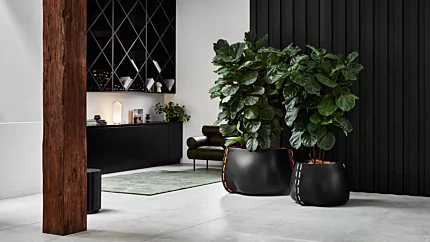
Start with the plant, because get that wrong and nothing above ground will save it. Then widen the lens to the room or terrace, because a planter that suits the plant can still look stranded or crowded in the setting. Concrete planter sizes are best read as proportions, not as numbers on a spec sheet. It helps to anchor the abstraction to a real piece: the Classic 125, the largest in Blinde Design's Classic series at just over a metre across, is the scale at which a planter stops being a detail and becomes an architectural gesture, while the Classic 25, at well under half that, sits as a quiet tabletop accent. The same form, the same family, four sizes apart in intent.
A plant needs room for roots and room to breathe above them. The horticultural team at NC State Extension recommends sizing a container roughly 5 to 10 cm wider than the plant's root ball so roots don't circle the walls or sit in constant moisture stress, with a minimum interior depth of around 15 to 20 cm for shallow-rooted specimens.
Scale up sharply for anything substantial. Research from the University of Georgia's horticulture program notes that large tropicals and palms want a container 90 cm or more across to develop properly and stay healthy over years rather than months. The instinct to "pot up a little" works against you here.
Depth deserves the same care as width. Jeremy Pickens at Alabama Extension found that over-deep planting starves the root zone of oxygen, raises disease susceptibility, and shortens a plant's working life. The fix is mechanical, not guesswork: planters in our concrete planters range use an internal drainage cell and a waterproof inner pot with a drip tray, so the plant sits at the correct height and the concrete never touches damp soil directly.
A planter has to answer to its setting as much as to its plant. In a generous room with high ceilings, a piece that looked imposing in the showroom can read as timid once it's home. The design editors at Architectural Digest make the point plainly: choose the largest planter-and-plant combination the ceiling height comfortably allows, and let the planted specimen work as a sculptural focal point that draws the eye upward.
Outdoors the calculus shifts to footprint. A terrace reads in plan, so a planter's plan area matters more than its height. Measure the path you walk and the sightlines you want to keep open, then size to leave them clear. The right scale leaves every path clear and every sightline intact, so the piece reads as intentional rather than imposed.
One large planter almost always beats several small ones of the same combined mass. Garden designer Debra Prinzing, writing for Houzz, observes that a single large-scale object carries more visual weight and composure than a scatter of smaller ones that add up to the same volume. The eye reads one confident gesture; it has to work to read five timid ones.
That said, a cluster has its own logic when the pieces vary in height and the grouping is deliberate. Three planters of stepped heights in a shared finish behave like a single composition. The trap is the accidental cluster, where odd pots accumulate over time and no two agree. If you want a group, design it as a group from the start.
Loading image...

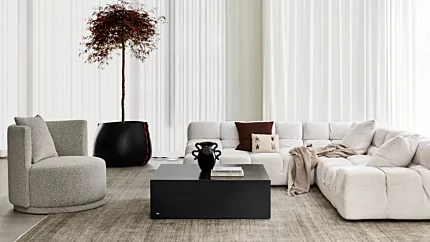
Finish is a mood decision before it's a colour decision. The same form in a different finish can read as warm and organic or cool and architectural, and the right call depends on what the surrounding room is already saying. Blinde Design offers three finishes across both the Classic and Stitch series, and each one points the piece in a distinct direction.
Concrete planter finishes work hardest when you choose them against the materials and light already in the space rather than in isolation on a swatch.
Natural, Graphite, and Bone are Blinde Design's three organic finishes, and the names map directly to what each one does in a room. Natural is the warm concrete tone, the most forgiving of the three. It reads as honest, slightly raw, and sits comfortably in spaces that lean organic or Mediterranean. Graphite, a deep charcoal grey, does the opposite: it recedes, anchors, and lends a hard-edged, contemporary seriousness, ideal where you want the plant rather than the pot to lead. Bone, an off-white ivory, lightens and softens; it brightens shaded corners and flatters pale stone and limewashed walls.
For an expressive lever beyond colour, the Stitch series, winner of the 2019 Good Design Award and the 2019 European Product Design Award, carries a decorative rope along its seam, available in six colours from quiet greys and whites to assertive reds and yellows. The rope is purely stylistic, a way to inject a thread of accent into an otherwise monolithic form, and it lets a single planter shift from understated to playful without changing its shape or finish. Each planter is individually handcrafted and carries its own serial number, so the piece you receive is not a catalogue item pulled from stock.
Concrete and timber are a deliberate pairing, not a default. Architectural writers at ArchDaily describe the combination as a rhythm built on contrast, where timber softens concrete's rigidity and concrete grounds timber's organic warmth. A Natural or Bone planter beside oak decking leans into that warmth; a Graphite piece against the same timber sharpens the contrast into something more graphic.
Light changes everything you just decided. Bone lifts a north-facing room that never gets direct sun, while the same finish under harsh midday glare on a rooftop can flatten to a glare of its own. Graphite holds its depth in bright light and can feel heavy in a dim interior. Before committing, set the finish where the planter will actually live and watch it across a day. Take the time to watch the finish in the actual light before committing, because a Blinde Design planter is a long-term piece, and getting the finish right at the start means it stays exactly where you want it for years.
That same care over light carries straight indoors, where placement is where "just add drainage" quietly fails. A planter indoors has to manage water without staining a floor, sit in proportion to the furniture around it, and land where the plant gets the light it needs, all at once.
Indoor concrete planters reward a little planning before they're filled, because once a large planter is planted and watered, moving it is a project rather than a nudge.
Water is the indoor risk, and it runs in two directions: down onto the floor and into the planter wall. Our planters address the second with a waterproof nano-coating and a sealed internal system, so the concrete itself resists moisture, stains, and watermarks. The floor underneath is your responsibility. On timber, stone, or a rug, set the planter on discreet feet or a protective pad so trapped moisture and mineral deposits never sit against the surface.
Watering discipline matters more indoors than out, where rain and evaporation forgive a heavy hand. The inner plant bag and drip tray catch overflow, but they are a buffer, not a licence to flood. Water to the plant's need, check the tray, and the system does the rest. A clear coat of car polish, applied once a year, restores depth of colour and lifts watermarks and light surface marks, the same routine recommended in the care guide. The same Fluid Concrete Technology runs across our coffee tables and stools, so a matched material story is there if the scheme calls for it.
Indoors, scale is about the furniture, not the floor area. A planter should hold its own against the sofa, the console, or the dining table it sits near, neither dwarfed by them nor crowding the walkway. A tall, slim planted specimen beside a low sofa adds vertical relief; a low, wide piece on a sideboard reads as a horizontal anchor. Decide which gesture the room is missing before you choose the form.
Then place for the plant, not just the picture. A fiddle-leaf fig that wants bright indirect light will sulk in the dim corner that looks best in a photo. This is where weight quietly earns its keep. Because our planters are built on a lightweight thin-skin construction rather than solid cast concrete, a piece that needs to follow the light, or move between rooms as the seasons turn, can be repositioned by one or two people instead of staying marooned where it was first set down.
Loading image...


That same lightweight construction is what frees the piece outdoors, where weight is the question most buyers don't think to ask until a balcony or rooftop is involved. At ground level, weight is an asset; up high, it becomes a load you have to account for. Lightweight concrete construction is what lets a sculptural planter go where solid cast concrete simply cannot.
Outdoor concrete planters face weather, movement, and in elevated settings, structural limits. Each setting changes what the right planter looks like.
On a patio, courtyard, or garden bed edge, weather resistance is the headline and weight is a feature. Heavier pieces shrug off wind and stay put without fixing, and our outdoor concrete planters need no mechanical fixing to the ground at all. Fluid Concrete Technology resists moisture, stains, heat, UV, and the freeze-thaw cycling that cracks lesser concrete over winters.
The freeze-thaw resistance starts with the material itself: once fully cured, Fluid Concrete Technology is non-hydraulic and doesn't retain water, so it sidesteps the expansion that splits saturated concrete when temperatures drop. Independent research on fibre-reinforced concrete published in the journal Fibers backs the principle up, showing how decisive water retention is, with reinforced specimens holding their integrity through hundreds of freeze-thaw cycles where plain concrete failed after a couple of dozen. A planter that survives one winter intact and crumbles the next is a false economy in any climate that freezes.
Yes, you can put a large concrete planter on a balcony or rooftop, provided you respect the surface's load rating and favour a lightweight build. This is where the question gets real, and where construction method, not just size, decides what's possible.
Residential balconies in Australia and the United States are engineered to comfortable margins, and the largest planter in our range spreads its weight over a wide footprint, giving a point load that sits well within a sound residential structure. Because our lightweight concrete planters use a thin-skin wall rather than a solid pour, the empty piece weighs a fraction of traditional concrete of the same size, which leaves more of your load budget for soil, water, and the plant itself. The practical recipe is simple: spread the load over a broad base, keep it clear of unsupported edges, and on an older balcony or any structure where you're unsure of the rating, have it assessed before you load it. With a sound structure and a lightweight build, a large concrete planter on a rooftop or balcony is a design move, not a structural compromise.
The three decisions resolve into something coherent the moment you make them together. Take a single sculptural floor planter for a double-height living room: the form is from the Classic series, chosen large to read against the ceiling height, in Bone to lift a north-facing space, sited where a fig can reach the window rather than where the camera would prefer it. Size answers the room, finish answers the light, placement answers the plant. None of the three was decided alone.
Now move to a rooftop terrace. Here a clustered arrangement earns its place, three pieces from the Stitch series in stepped heights, their oval forms and a shared rope detail tying them into one composition, all chosen for a lightweight build that the structure can carry. The Stitch series, winner of the 2019 Good Design Award and the 2019 European Product Design Award, does the aesthetic work; the construction does the structural work; the grouping does the spatial work.
Underneath both scenarios sits the material story. Fluid Concrete Technology is made from 95% recycled natural materials, absorbs CO2 as it cures, and is fully recyclable, so the material's environmental credentials are as considered as its surface finish. The full account of how the material is made and why it lasts lives with our concrete planters collection.
Choosing concrete planters well is less about picking a product and more about resolving three decisions that depend on one another. Size sets the proportion, finish sets the mood, and placement sets the constraints, and a choice made in one quietly rewrites the options in the other two. Read them together and the piece settles into a space as though it was always meant to be there.
That interdependence is exactly why concrete rewards a considered hand. Its weight, its surface, and its longevity are assets when the scale suits the room, the finish answers the light, and the surface beneath it can carry the load, and liabilities when any one of those is treated as an afterthought. Concrete planters are a long-term material choice, not a seasonal one, and the planters that look effortless years from now are the ones whose size, finish, and placement were decided in the same breath.